Space Raccoons : Raccoons in Space
A Chaotic Tabletop Card Game.
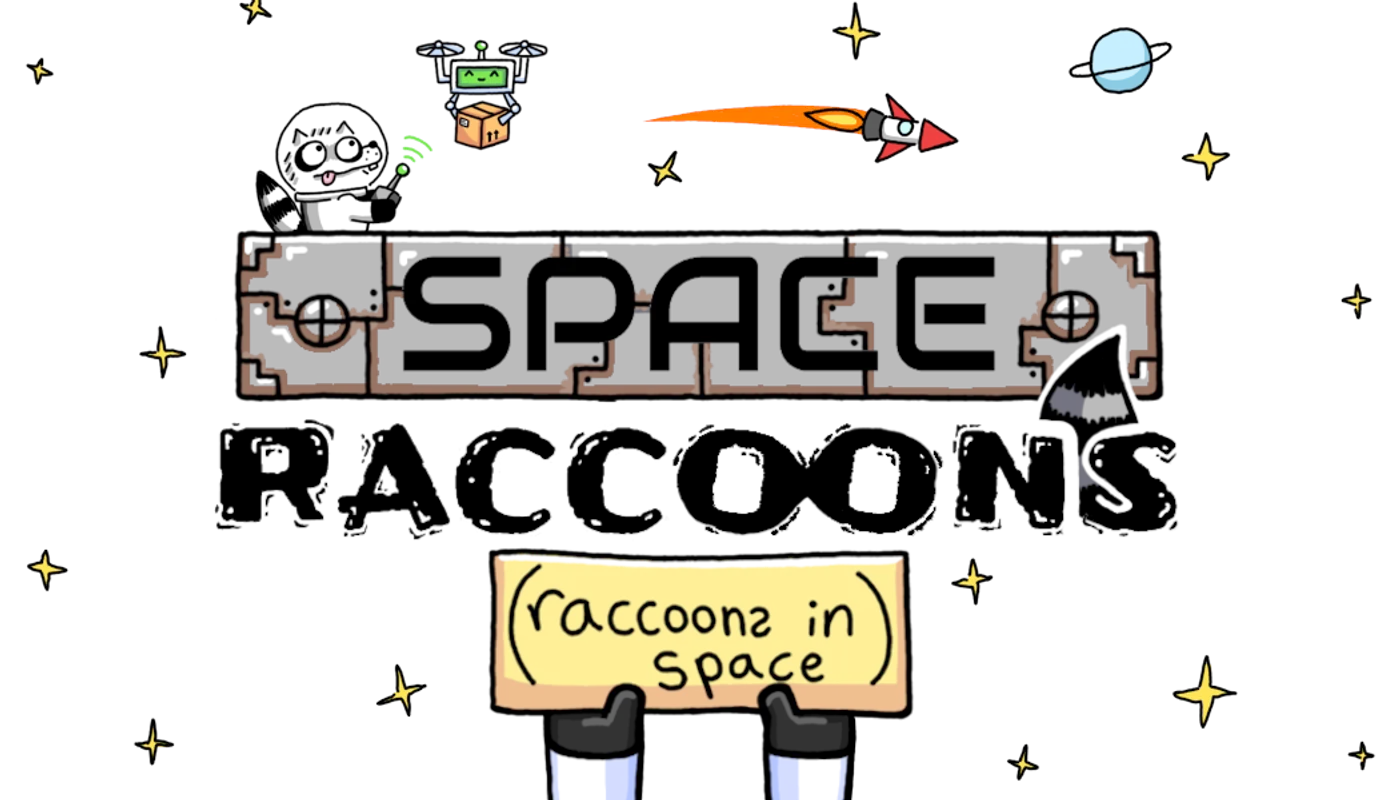
In Space Raccoons : Raccoons in Space, play as a raccoon rummaging through piles of space trash, trying to find the coolest trash before anyone else.
Space Raccoons has undergone a successful launch underneath Trashtronauts LLC, where it underwent a Kickstarter crowdfunding campaign.
Currently the game is under production, and will reach backers soon.
Design Journey
A brief overview of the game’s design and journey over multiple years.
Beginnings
Space Raccoons derived from the question, “whats a funny animal to make a game from?”. Design originated from a set of questions much like these.
Now, what do Raccoons like?
Trash
What could trash be represented by?
Stacks of Cards
Whats a fun spin on trash and raccoons?
Space
My goal for the game was to make the player feel like they were rummaging for cool trinkets within a chaotic and whimsical dumpster. With raccoons trying out pieces of trash-tech thrown out for good reason. Trash flying through the air. And nefarious aliens trying to hitch a free ride.
Core Design
The core design of Space Raccoons is based in the cards. Cards could either be played for an effect, or stashed for points. Cards also made the primary interaction space within the “Trash-Heap”. The Trash Heap is where the piles of cards exist, and players must search through these piles to get the cards they want. Cards can be moved, revealed, hidden, and drawn within this space. Hazards also populate the heap, providing some risk to blindly drawing. There is no limit to the number of stacks that can exist in the game.
The Trash Heap existed as stacks of cards to mimic chaotic piles of garbage. And cards, being individual pieces garbage, could be used again after playing. Played cards re-entered circulation a turn after playing, allowing multiple players to access the same coveted cards.
Players take turns drawing cards, playing cards to collect other cards, and stashing cards for points. This proceeds until the game ends, and players count the points in their stash.
Brief History
The first prototype of Space Raccoons was with a deck of playing cards. Stacks of such cards represented piles of garbage, and each had a point value. Players would take turns revealing and moving cards.
The core gameplay then, which is still how the game functions today, was revolved around manipulating, collecting, playing and stashing cards. Whoever had the most points at the end of the game, won the game.
Soon enough, art and effects were attached to those cards. Cards could either be played for an effect, or “stashed” for points (scored at the end of the game). The points system to win the game settled on a set scoring system. Cards belong to sets, which scale up in point value the more a player has. two other types of cards existed, the “Typeless” cards with a static point value. And “Hazards”, who would make rummaging through trash have some exciting risk.
Space Raccoons was prototyped for over two years and had numerous iterations. Mechanics were cut, readded, and cut again. Each iteration brought different challenges.
The earlier iterations were overcomplicated for the games experience goals. Mechanics such as items were simplified, all cards could be played or stashed, with few corner cases. Cards designs and rules systems were framed within the experience. “Does this feel like a chaotic space landfill with raccoons?” If yes, it was kept, if no, it was refined. The game ended with enough complexity for a seasoned player to enjoy, and enough simplicity for new players to pick up the fundamentals. The simplest strategies were often the best, and depth was built into the systems to be discovered with each playthrough.
Prototyping and playtesting were integral to the game’s process, creating solutions to design problems. For example, the original end of the game was after 7 rounds had passed. This was hard to keep track of. The “Rummage Deck” arrived as a solution. A separate deck where players would be able to draw from at the start of each round. This acted as a built-in round tracker, as when it ran out, the game ended.
Eventually, system and card balance changes slowed down. It was easy to get caught up in making the perfect game, iteration had been going for years and it was easy to believe it could go on for many more. I felt like the game was a hamster in a wheel. There are certainly band-aids on some systems to keep them functional that I will forever haunted by. Yet, the game worked, and… it was fun. Players were having fun during tests, and many testers was asking when they could buy the game.
To me, the game never really felt like it was ready for a launch, I don’t think it ever would have “felt” ready.
It was. So we launched it.
Contributions
Being on a team of 3, we all wore many hats to make this game a success. Below are the areas where I had my greatest contributions to the project.
Design & Prototyping
I created and balanced the cards and systems of the game.
I was not alone in my work on this, and worked closely with Brandon Korn and William Buxton on the games design.
I was responsibility for the prototyping aspects of the game.
Using Python, Gimp and Photoshop, I had a card production workflow to rapidly iterate on card ideas.
Each week, a new prototype was tested, feedback accumulated integrated into a new iteration.
This process was arduous early, and I refined it over time, using scripts and automation to speed up prototyping.
Such iteration was vastly important to the project.
Card Creation & Asset Pipeline
Touching again on the automation, I created the cards within the game. I contributed to their design and created the layout for each card. Early on, this was a manual process, making prototyping slow and painful. To speed up development, I setup systems of scripting and automation to populate cards from a spreadsheet. With a click of a button I could make 200 test cards, perfect for rapid iteration.
Production
I led production effects both in terms of the teams process, and the actual production of the game. In terms of process, I set timelines, deliverables, goals and documentation. The project operated on a 1-week sprint structure to account for weekly playtesting. Feedback from a playtest was used to guide the next week’s work. As the game entered production, the timeline shifted. The Kickstarter campaign demanded polish, and rather than focus on design iteration, finalized assets and marketing became the new focus. I managed the actual production of the game as we entered our final phases. I ensured assets were in the proper template and format for printing. I communicated with our production company, sending proofs and ensuring quotes were established. All of this work was essential to build up our Kickstarter timeline, as well as the asset production that followed. All in all, I managed a successful Kickstarter campaign, where production of the game is nearly complete.